
CK-12 Flexi
An AI tutor has to satisfy a student who wants the answer, a teacher who needs the learning to survive, and an institution that needs to trust both.
- Role
- Lead UX Designer
Research, UX/UI design, and prototyping with product, engineering, and curriculum partners
Product case study
Published classroom research describes useful support alongside prompting, comprehension, and tone barriers. Activity alone is not evidence of learning.
On this page
Context and ownership
Flexi is CK-12's AI student tutor. As Lead UX Designer, I worked on the learning experience with Product, Engineering, Data Science, curriculum, and research partners. My work connected the tutor's capabilities to interactions a student could understand and use.
The design problem was to help students through a point of confusion while keeping the learning effort with them. CK-12's overall platform reach is not a measure of this feature's impact.
The tension
Refusing help can drive a student away. Supplying an answer without a path to understanding can turn the tutor into a shortcut. The interaction needs a useful middle: help now, followed by a clear way to clarify, practice, or go deeper.
That also creates different expectations. Students want immediate assistance; teachers care about understanding and over-reliance; institutions need confidence in the experience students encounter.
Decision 01
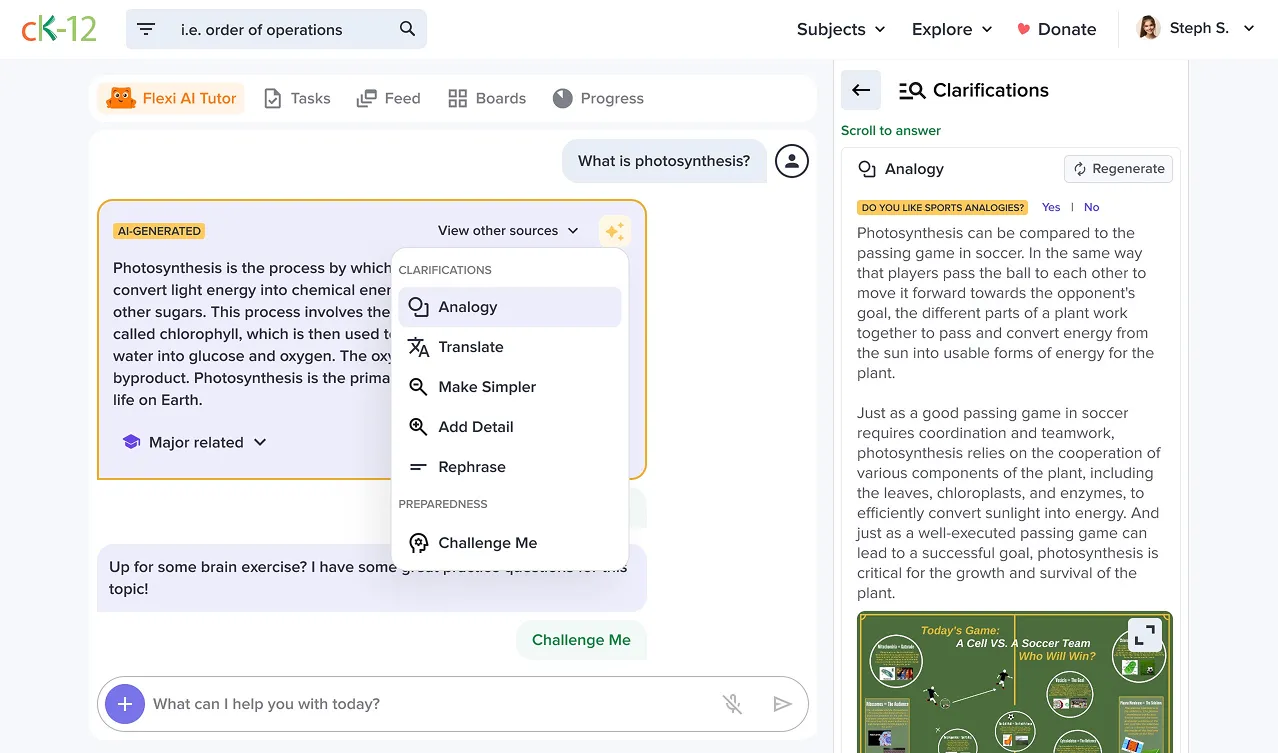
A blank prompt assumes a student knows how to ask for better help. The supplied interface makes follow-up actions visible: simplify, add detail, use an analogy, translate, rephrase, or try a challenge.
Those actions give the student ways to continue beyond the first answer. The tradeoff is between useful guidance and a menu that asks for another decision when someone is already confused. That makes the clarity of each choice part of the learning experience.
Decision 02
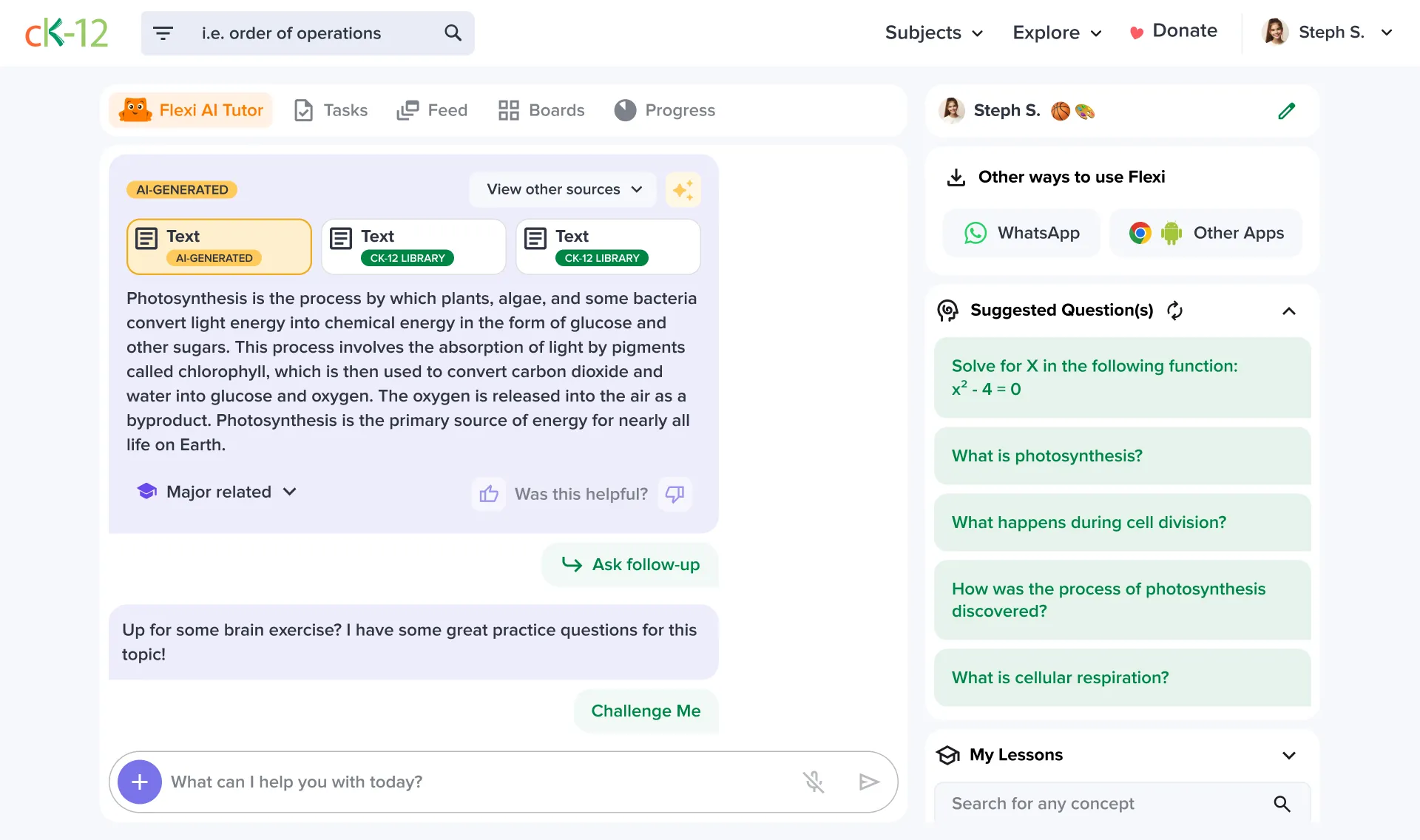
The interface distinguishes AI-generated content from a CK-12 Library explanation and lets students ask for a different explanation. Source labels and follow-up controls provide concrete points of orientation.
A source label is not a confidence estimate. The next question is whether a student recognizes when an explanation is not helping and can use these choices to recover.
Boundary
Teachers need to understand whether help is supporting learning or replacing it. This article demonstrates the student experience; teacher monitoring and pause controls are not substantiated by the available artifacts.
The separate Foresights and Insights case study covers teacher analytics. It addresses interpretation of assignment evidence, a distinct problem.
Published evidence
CK-12's Spring 2025 Flexi study(opens in a new tab) followed ten middle- and high-school teachers over six weeks, using surveys, diaries, focus groups, and interviews. It described engagement and confidence alongside barriers in prompting, comprehension, and tone, plus concerns about over-reliance.
I use this published research to evaluate the design question. I do not claim that I authored the study or that these later findings caused each interface decision shown here.
Interaction model
An explanation, its source, and the next learning action belong together. Separating them makes the student do more work to recover when the first response misses the mark.
This model connects content and interaction. It does not establish that the system can infer understanding from engagement alone.
Product
The product image at the top shows the follow-up menu alongside the conversation. The important detail is the invitation to choose the kind of help, rather than requiring the student to invent a better prompt.
Evaluation
CK-12's analysis of student dialogue(opens in a new tab) examined a sample of 5,000 students and selected 15 cases for closer qualitative study. It distinguishes deeper learning-oriented exchanges from more superficial use.
That supports studying the quality of a conversation. It does not isolate the effect of this interface or establish that my design caused an academic gain.
Next question
I would evaluate follow-up choices with a task that requires students to explain or apply what they learned afterward. The question is whether the support helps them proceed independently, not whether it increases message volume.